Unit Posts
Here are 4 posts from the first semester, 1 from each unit. I don’t think these four units are necessarily inner connected. I would rather look at the first two posts more as the foundation that leads to the latter 2. John Locke’s theory on the inalienable rights of men is the foundation theory for almost all nations nowadays, but it is flawed because of its ingrained discrimination against anyone that’s not a white male. The Scientific Revolution is a turning point in human history because it directly leads to the Age of Exploration and colonization. Slavery and colonization created by the first two posts then directly led to problems such as the Rwandan Genocide and the discrimination against the African Americans.
Unit 1: Choose a passage from John Locke’s Two Treatises and explain why.
Men being, as has been said, by nature all free, equal, and independent, no one can be put out of this estate and subjected to the political power of another without his own consent, which is done by agreeing with other men, to join and unite into a community for their comfortable, safe, and peaceable living, one amongst another, in a secure enjoyment of their properties, and a greater security against any that are not of it. This any number of men may do, because it injures not the freedom of the rest; they are left, as they were, in the liberty of the state of Nature. When any number of men have so consented to make one community or government, they are thereby presently incorporated, and make one body politic, wherein the majority have a right to act and conclude the rest. (Paragraph 95)
The reason I chose this passage is that Locke introduced the concept of the social compact and its mechanisms to his readers. Throughout the “Two Treatises”, Locke’s primary object was to figure out the origin of political power that is not “Divine Right”, as argued by Filmer. And this idea of “social contract” was his answer. Locke argued that the origin of political power came from people’s voluntary sacrifice of some of their perfect freedom and equality to make sure the world in which they live doesn’t fall apart. He also argued that an ideal government should always make its decisions based on the consent of the majority, without which the government would be illegitimate.
The underlying statement of this concept, which Locke inferred in the passage, is that since the government started as a social compact between the people, the people should have certain power and responsibility to overthrow the government when the majority of them believe the government is failing at doing its job. This is the very idea that inspired the Founder Fathers of the United States to start a revolution against Great Britain after the British started collecting all different taxes that weren’t accepted by the colonists. If we look at the language of the Declaration of Independence, we can find plenty of influence by Locke. One of the most famous lines in the Declaration of Independence: “We hold these truths to be self-evident, that all men are created equal, that they are endowed, by their Creator, with certain unalienable Rights, that among these are Life, Liberty, and the pursuit of Happiness” is directly influenced by Locke’s idea of “state of perfect freedom and equality” enjoyed by all men.
Why would anyone give up freedom in the state of nature?
Unit 2: The early modern view of “the connected world” (ch. 2) is an example of a large-scale conceptual scheme. See if you can describe this worldview in your own words. Are there any parts of it still present in contemporary science? (See p. 38 for some suggestions—try to expand on these or come up with your own examples.)
The early modern scholars believed in the interconnectedness of every element in the world. Influenced by the neoplatonists and Aristotle, they believed that everything in the world exists for a purpose and the ultimate purpose of knowledge is to define objects in the context of their relationships to other objects. Under this grand conceptual scheme, the early modern scholars created a system to connect the knowledge of God, humanity, and nature. Some of the early modern scholars even ventured to not only learn but to control the connections between various elements, which were formerly believed to be only God’s power. Through practical applications such as alchemy, biology and astronomy, these scholars pioneered in the realm of science.
Though centuries have passed since the Scientific Revolution, we can still find residues of the belief in a cosmically interconnected world in the present day academic world. Take politics for example. The politics of a specific area is always a complicated issue. It is always a mixed result of history, economic interest, natural resources, and the ideologies of that region. So if one wants to master the politics of a region, he/she will have to master all these aforementioned subjects. And thinking from a different angle, politics also serves as a venue to combine these different branches of knowledge.
How did the psychology(mindset) of a period influence the scientific progress of that time period?
Unit 3: As you read Gourevitch (147-171) and Sontag (chapter 4 and pages 125-26) think about why we are reading these together. For you post, write a paragraph in which you provide connections between two texts.
Both Gourevitch and Sontag’s reading from this weekend discussed the idea of how the major powers in the world are still in the eurocentric mindset, even when dealing with issues like the Rwandan genocide. Gourevitch reasoned that U.S. was almost single-handedly responsible for the happening of the Rwandan genocide because of the U.S. reluctance to get involved in UN peacekeeping missions. She also argued it was very sarcastic that Europe has poured in tens of thousands of troops and billions of dollars to help stop and relieve the Bosnian genocide while it took UN three months to even start using the word genocide to describe what was happening in Rwanda. She concluded that world powers, in this case mostly Europe and the U.S., tend to treat tragedies differently according to the “closeness” to themselves, which links to Sontag’s point. Sontag argued that press in Europe and the U.S. tend to show more gruesome pictures from faraway places because these pictures “nourish belief in the inevitability of tragedy in the backward parts of the world.” She ascribed this phenomenon to the centuries-long custom of exhibiting exotic, or colonized, human beings.
Unit 4: Post on March Book 2
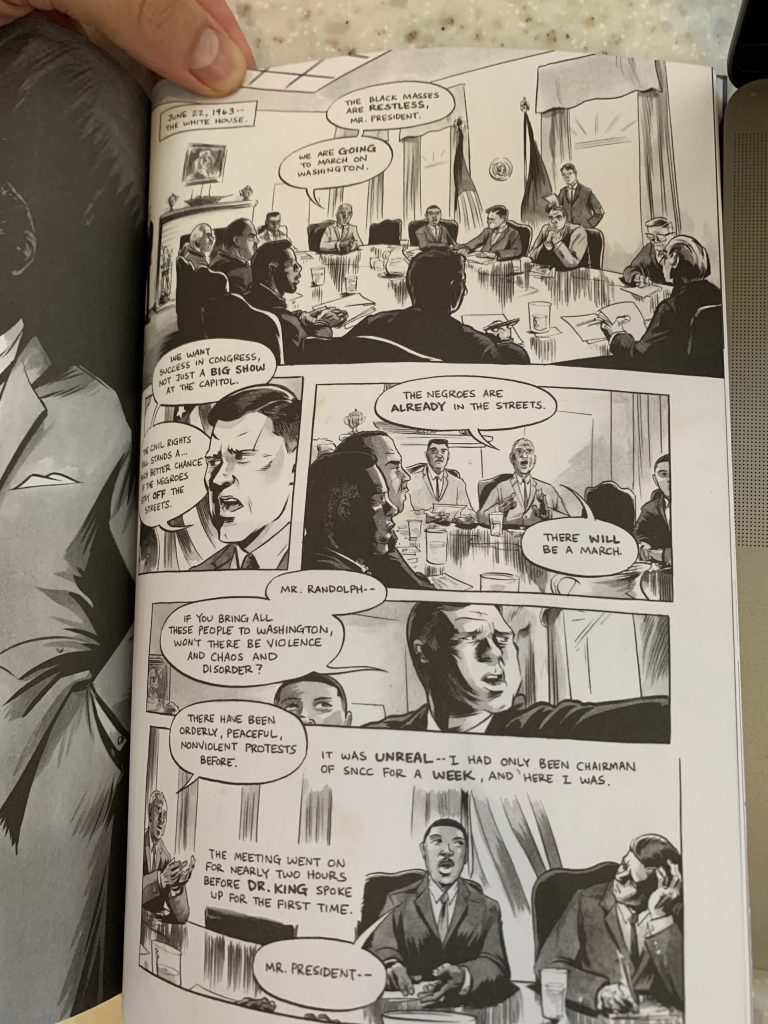
This page of pictorial depiction accurately depicts the meeting that President Kennedy and his cabinet had with the leaders of the civil rights movement to discuss the March in Washington. The artists of the graphic novel decide to add in plenty of dark color by drawing shades on characters’ faces. The frequent utilization of dark color in most of the panels on this page, along with the dark background on the page before which introduced A. Phillip Randolph, suggests the intensity of the meeting. The very first panel, which occupies almost half the space on the page, depicts an overall settings of the meeting. It shows a dozen or so men sitting around a table, all dressed in a jacket and tie. President Kennedy is shown sitting amongst his staffs and advisors on the right side of the able. On the left side of the table, across from President Kennedy, sit the leaders of the Civil Rights Movement. This specific sitting arrangement in panel one suggests the division of members of the meeting and the subtle attitude President Kennedy had towards the Civil Rights Movement. Moreover, the facial expression of the characters indicates the meeting was not going smoothly. This meeting was essentially a negotiation between the United States government and the leaders of the Civil Rights Movement. However, looking at the face of every one of the characters, one can easily tell that nobody in that room is satisfied with the current situation and yet no one is willing to compromise. The second panel is a solo portrait of President Kennedy. With his eyebrows clenched together and mouth wide open, most likely yelling, this panel depicts President Kennedy as a intimidating negotiator who was using the passing of the Civil Rights Bill as a leverage to threaten the black leaders to give up the march.
Besides visual element, the arrangement of the text on page 147 also help to illustrate the intensity in the meeting room. The artists’ bold several words throughout the page to emphasize the tone of the speaker. For example, in panel one, Randolph says to President Kennedy that “THE BLACK MASSES ARE RESTLESS, MR. PRESIDENT. WE ARE GOING TO MARCH ON WASHINGTON.” Here, by bolding the words “restless” and “going”, the artists are able to emphasize the extreme anger shared by African Americans and their determination to march on Washington to demonstrate their aim.
